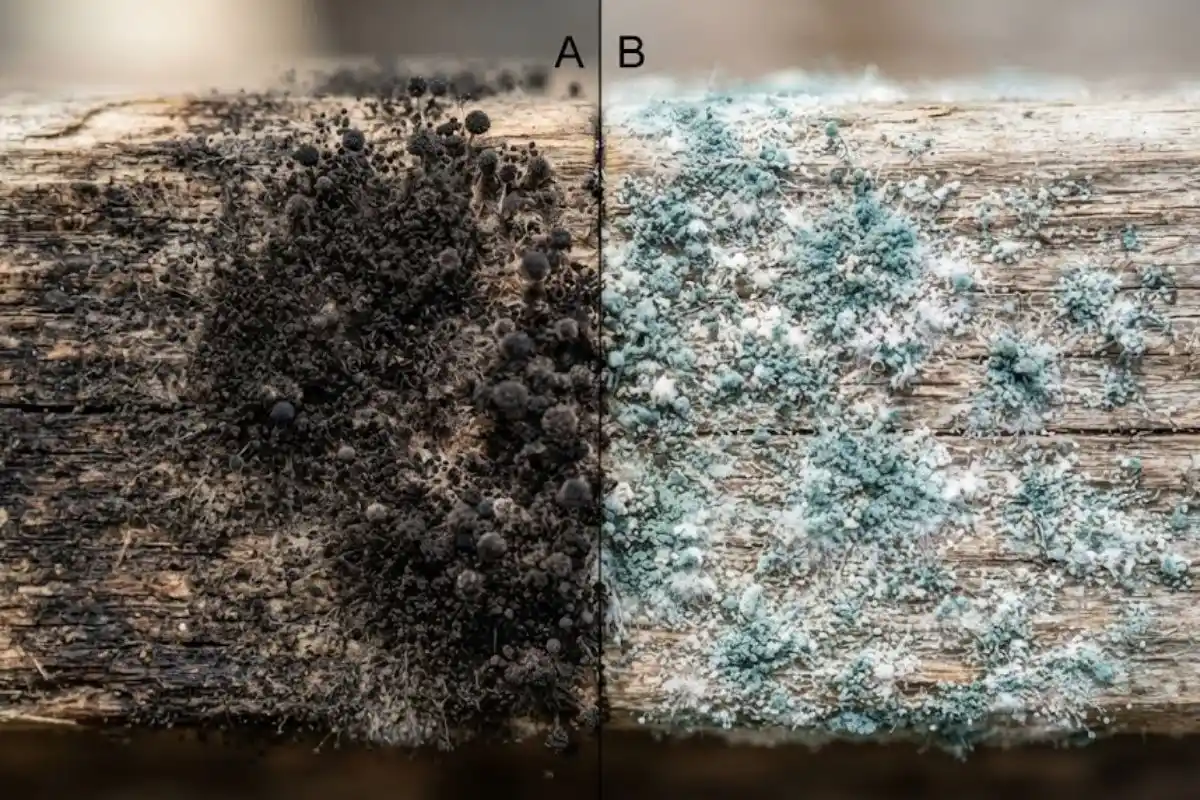
Find dark mold in your house and the internet will meet you with two unhelpful extremes: panic content insisting you've discovered a toxic emergency, and dismissive content insisting it's all overblown.
The truth sits in the middle and is genuinely useful: color alone cannot identify mold species, “black mold” is a real thing with real requirements, and the correct response to dark growth is mostly the same regardless of which species it turns out to be. Here's how to think about it clearly.
What People Mean By Black Mold
The phrase almost always refers to Stachybotrys chartarum, a greenish-black species that earned its reputation through association with water-damaged buildings and health complaints. Stachybotrys is distinctive less for its color than for its demands: it colonizes cellulose materials (drywall paper, ceiling tile, wood fiber) and requires sustained saturation, typically a week or more of continuous wetness.
To establish. It doesn't grow from a splash or a humid afternoon. Finding it is therefore diagnostic: somewhere, water has been present continuously, whether from a slow leak, chronic seepage, or a water event that never properly dried.
Here's what surprises people: many common household molds also grow dark. Cladosporium, among the most common molds on earth. Shows up olive-green to black on bathroom surfaces, window sills, and walls. Some Aspergillus varieties run dark.
Even ordinary mildew reads “black” in bathroom grout. Visual identification across species is unreliable enough that professionals don't do it by eye either, that's what lab analysis is for.
Does The Species Actually Matter?
Less than the panic content suggests, more than the dismissive content admits. On health: mold exposure of many species is associated with respiratory irritation, allergic response, and asthma aggravation, with individual sensitivity varying enormously, and children, older adults, and immunocompromised or respiratory-sensitive people warranting more caution across the board.
Stachybotrys draws extra concern for the toxic compounds it can produce, and the research there is genuinely more measured than the headlines, but no finding in that research suggests living with active colonization of any species is fine.
The practical health position doesn't require settling the scientific debates: nobody should share air with an active colony, and disturbance without containment measurably increases exposure to whatever the species is.
On response: species changes the containment rigor and documentation, not the fundamental approach. Colonized porous materials get removed, not sprayed; the moisture source gets found and fixed; the work happens under containment proportionate to the growth's extent and suspected species.
This is why our black mold removal protocol and general mold removal protocol share a spine. The black-mold version runs the same discipline at higher intensity.
When Testing Is Worth It, When It Isn't
The species question leads naturally to testing, and the honest guidance is situational. Testing earns its cost when species drives decisions: suspected Stachybotrys (because it confirms both the species and, implicitly, the long-duration moisture story), health symptoms that need an implicated-or-cleared answer, real-estate transactions requiring documentation, and post-remediation clearance.
Testing is a poor buy when you can see mold and already intend to remove it.
The lab will confirm what your eyes established, and the money is better spent on the removal. We turn away testing revenue on exactly this logic regularly; the longer version of when-and-why lives on our mold testing page.
The Question Better Than “What Species Is It?”
The more useful question about any mold, dark or otherwise: what moisture grew this? Mold is always downstream of water, and the growth pattern reads like a map.
Growth tracking a line or concentrated at one spot follows a leak, plumbing, roof, or the site of a past water event. Growth scattered across cool, low-airflow surfaces, closet walls, behind furniture on exterior walls, basement corners, follows condensation and humidity, no leak required.
The distinction decides the fix: leak mold ends when the leak ends and the remediation completes; humidity mold returns after any cleanup until dehumidification and airflow change the room's physics.
Dark mold with the Stachybotrys signature, on saturated cellulose, in a place with a continuous-water story. Makes the moisture question urgent, because whatever is keeping that material wet has been running for a while.
What To Do With The Dark Patch You Just Found
Regardless of species: don't scrub it, don't spray it, don't run a fan at it, disturbance aerosolizes spores, and bleach on porous materials is the classic move that makes everything worse while looking productive.
Photograph it from a distance, note anything you know about moisture in that spot's history, keep the area closed off from daily traffic, and get an assessment. A professional visit answers the real questions in an hour. What's the moisture source, how far does the growth extend beyond the visible, and what's the honest scope.
And if sampling is genuinely warranted, it happens then. The color of the patch will turn out to matter far less than the water behind it, which is the most reliable single sentence in this entire subject.
The One-Paragraph Version
If you keep a single takeaway: treat every mold finding as a moisture finding first.
The dark patch that turns out to be common Cladosporium and the one that labs as Stachybotrys both grew because water was where it shouldn't be, and both fixes run through the same sequence, find the moisture, fix the moisture, remove the growth under containment, verify. The species question refines the protocol; the water question decides whether the problem ends.
Panic buys nothing, dismissal buys a bigger job later, and the assessment that answers both questions costs an hour. That's the whole subject, stripped of its internet costume.
And if the patch you found is in a basement, bathroom, or closet, the three rooms that generate most of our mold calls. The room itself is a clue about the moisture type, which the earlier sections of this post will already have suggested to you.
Dealing with this right now in the Montgomery Village area? Our dispatch line is answered 24/7: (240) 207-7823