Montgomery Village · Gaithersburg · Montgomery County, MD
24/7 Dispatch · (240) 207-7823
Water DamageServicesFire DamageMold Remediation
Water Damage Services

Commercial Water Damage Restoration In Montgomery Village, MD

For a business, water damage is measured in closed days, not just repair costs. A sprinkler discharge, a failed water heater above a suite, or a roof leak over inventory turns into lost revenue the moment the doors can't open. Our commercial restoration work in the Montgomery Village area is built around one priority: getting you operational again, with the restoration scheduled and staged around your business rather than the other way around.
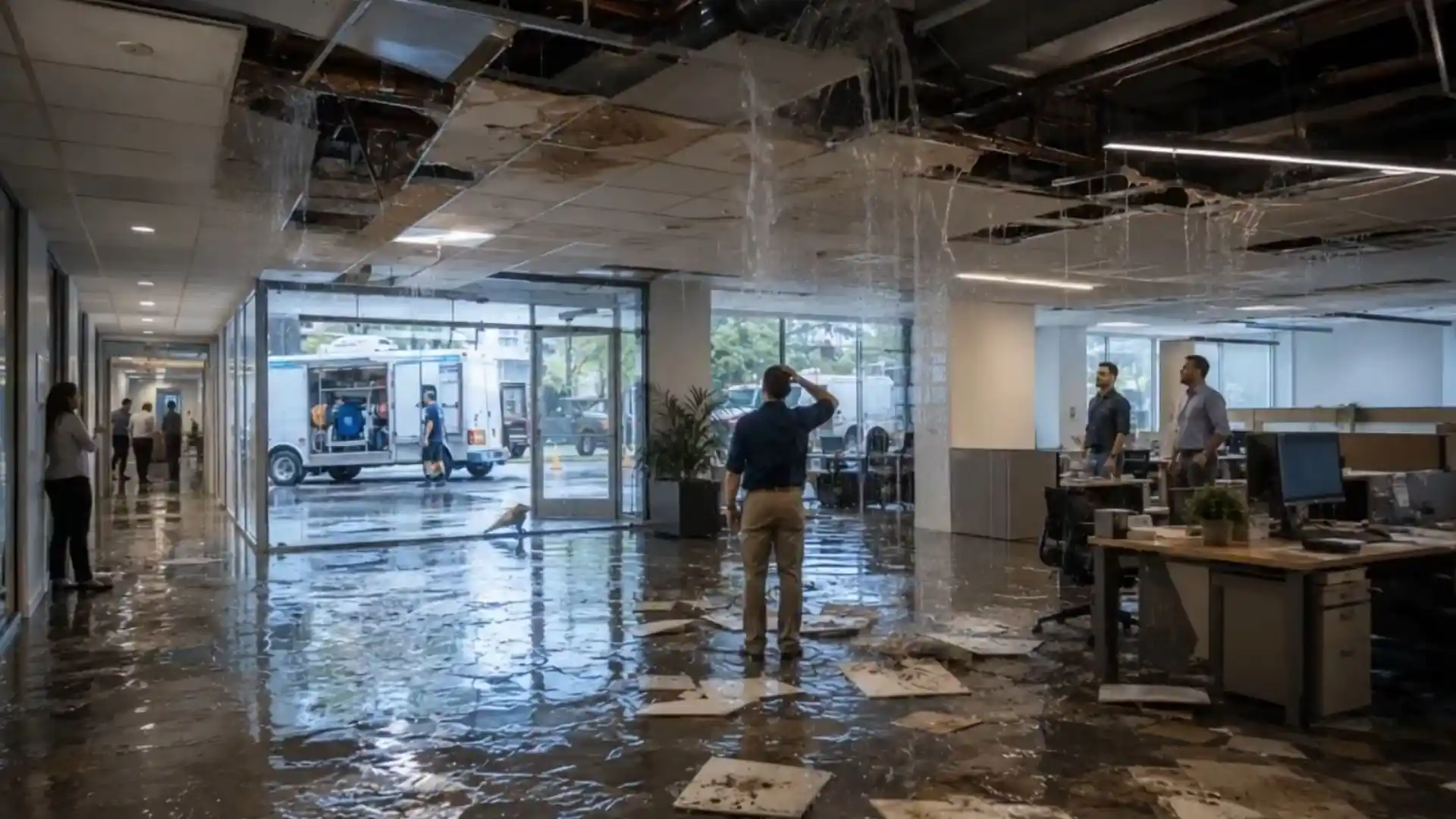
Commercial water damage drying equipment in an office space in Montgomery Village, MD
24/7 Emergency ResponseCrews dispatch immediately, any hour
☎ Call Now
🛡️Licensed & Insured Crews
📋Insurance & HOA Documentation
⏱️24/7 Emergency Dispatch
📍Serving Montgomery Village & Montgomery County

Commercial Losses Are Different Problems

A commercial water loss has variables a residential job doesn't. There are tenants and lease obligations, a property manager who needs documentation formatted for a commercial policy, business-interruption coverage questions, and often other suites sharing walls, ceilings, or risers with the affected space.

Water from a second-floor office suite doesn't stay in that suite, it finds the ceiling grid of the tenant below, and now two businesses and a landlord are involved in one claim.

We structure commercial jobs around those realities. Assessment covers every space the water could have reached, not just the one that called. Documentation is produced per-affected-space so each tenant and the property owner can each file cleanly.

And the work itself is scheduled to minimize closure. Overnight drying equipment placement, contained work zones so unaffected areas stay open, and staged repairs that let you operate around the work.

The Local Commercial Landscape

Montgomery Village's commercial spaces run from professional suites and service businesses along Montgomery Village Avenue to the retail and mixed-use activity around the former Lakeforest Mall site, long the community's commercial anchor and now in redevelopment, which means construction-adjacent properties, changing drainage patterns, and buildings in transition.

Transitional commercial corridors like that tend to generate a particular kind of water loss: vacant or renovating spaces where a small leak runs undetected for days, then shows up as a major saturation event in an occupied neighboring unit.

If you manage property near active redevelopment, more frequent walk-throughs of vacant units during the construction period are cheap insurance. And if mold has already gotten a head start in a space that sat wet, our commercial mold remediation team handles containment and removal with the same minimal-disruption approach.

What A Commercial Engagement Looks Like

The first call gets an emergency response, same as residential, extraction and stabilization don't wait for business hours. From there: a documented scope of work per affected area, moisture mapping to establish the full footprint of the loss, mitigation and monitored drying with equipment placed to keep egress and operations clear, and a written completion report with final moisture readings.

For multi-tenant buildings we coordinate directly with the property manager and can communicate with each affected tenant's insurance carrier separately.

Business Interruption Coverage And Commercial Restoration Timelines

Commercial water losses carry a financial dimension residential losses don't: business interruption. Many commercial property policies include business interruption coverage, which compensates for lost income and continuing expenses while a property is unusable, but that coverage typically depends on documented restoration timelines and evidence that the business made reasonable efforts to resume operations quickly. This is part of why our commercial response prioritizes speed and phased reoccupancy over a single finish date; every day a commercial space stays closed has a dollar value attached to it that residential losses simply don't carry.

Commercial-grade drying equipment differs from residential equipment mainly in capacity and deployment speed. Large-capacity desiccant dehumidifiers, capable of processing far more cubic footage than residential LGR units, are standard for warehouse, retail, and office losses where square footage runs into the thousands. Equipment placement also has to account for occupied space, foot traffic patterns, and sometimes life-safety code requirements that don't apply to a residential basement.

Tenant improvement coverage is another commercial-specific wrinkle worth understanding. In leased commercial space, the landlord's policy typically covers the building's core and shell, while tenant improvements, the buildout a business added, like custom flooring, built-in fixtures, or specialized electrical, often falls under a separate tenant policy or lease provision. Our documentation splits damage by these categories from the start, which prevents the finger-pointing between landlord and tenant insurers that otherwise slows commercial claims down by weeks.

Preparedness Pays: A Note For Property Managers

The commercial losses that resolve fastest share one trait: someone knew the building. Shutoff locations mapped and labeled, after-hours contact chains current, and a restoration contact already in the file, those three items routinely cut a day off response time, and the first day is the expensive one.

If you manage commercial or multi-tenant property in the Montgomery Village area, we're glad to be that contact in advance: a brief walkthrough of shutoffs and risk points costs nothing and means the 2 a.m. call, when it comes, starts with “we know your building” instead of twenty minutes of orientation.

Water losses at commercial properties are rarely preventable in the absolute; the size of the loss almost always is.

One more scheduling note: commercial drying often runs on an inverted clock. Equipment placed at close of business, run overnight at full capacity, and repositioned before opening.

It stretches the calendar slightly compared to continuous operation, but for customer-facing businesses the trade is usually worth it, and we'll model both timelines during assessment so the choice is yours with real numbers attached.

Common Questions

Commercial Water Damage Restoration FAQ

Can we stay open during commercial water damage restoration?

Often, yes. It depends on the footprint of the loss. Contained work zones, overnight equipment operation, and staged repairs let many businesses keep operating in unaffected areas. During the initial assessment we'll tell you plainly which areas can stay in use and which can't.

Who files the claim in a multi-tenant water loss, the tenant or the landlord?

Frequently both, under different policies: the property owner's policy typically covers building structure, while each tenant's policy covers their contents, improvements, and business interruption. We produce documentation per affected space so each party can file under the correct policy without waiting on the others.

How fast can you respond to a commercial loss after hours?

Dispatch runs 24/7, and after-hours is actually when many commercial losses are discovered, a cleaning crew or an opening manager finds the water. Calling the moment it's found rather than waiting for morning routinely saves days of drying time.

Related Services

You May Also Need

Water Mitigation

View Service →

Commercial Mold Remediation

Full Service Details →

Water Loss At Your Business?

Emergency commercial response, day or night, with a restoration plan built around staying open.

☎ Call (240) 207-7823