A soft spot in the ceiling. A stain that keeps growing. A bulge that looks like it's about to let go. Ceiling water damage is one of the most common calls we take in Montgomery Village, and nearly every one traces upward to the same handful of sources, an upstairs bathroom, a plumbing line in the floor cavity, or in the Village's townhome clusters, sometimes a neighbor's plumbing entirely.
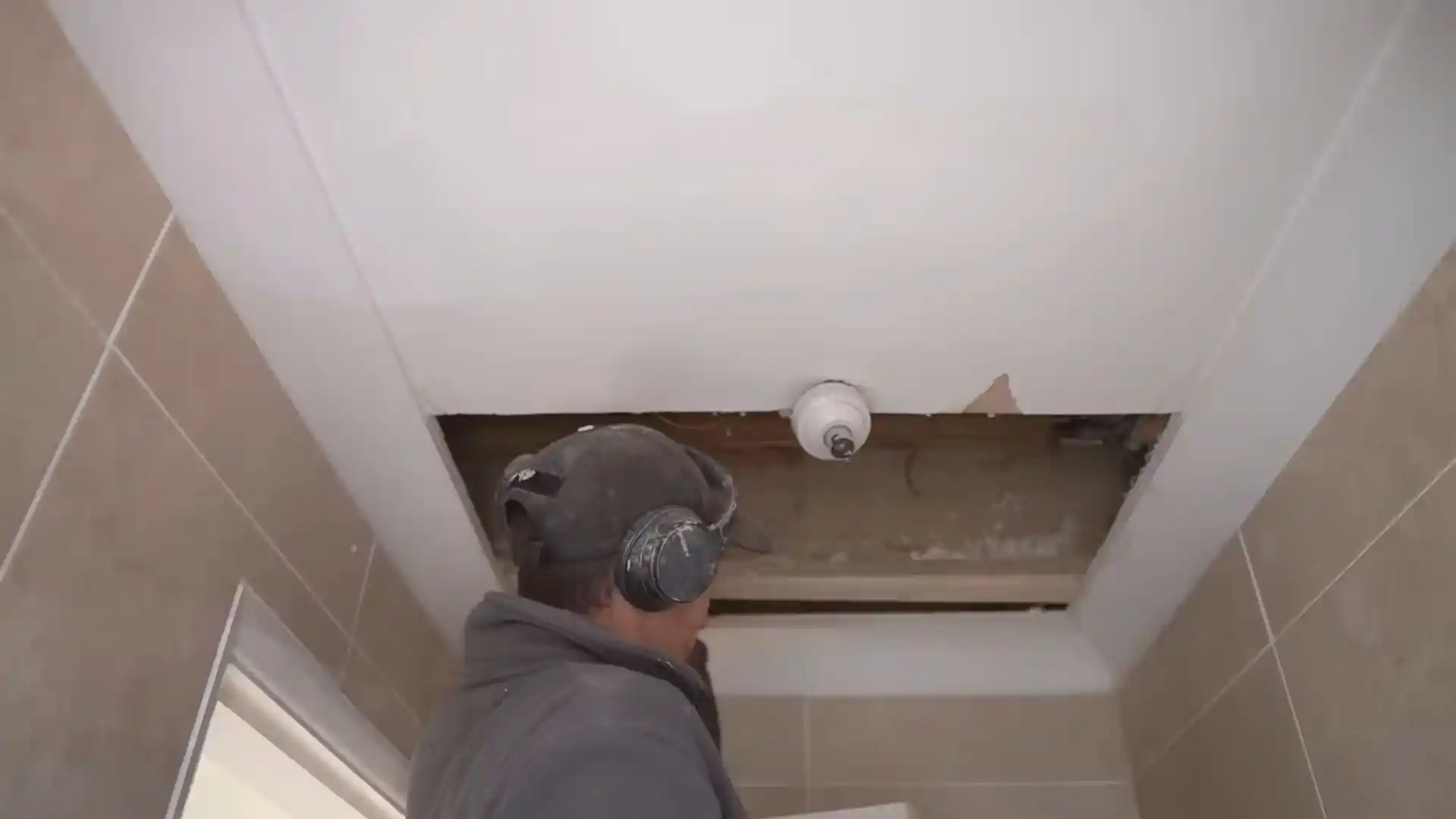
When homeowners call about a ceiling stain, the words we hear most are “soft spot” and “there's a hole starting to form.” The usual story: a toilet wax ring, a tub drain connection, or a supply line in an upstairs bathroom has been leaking slowly into the floor cavity, and the ceiling below absorbed water for days or weeks before showing it.
By the time drywall sags or softens, the cavity above it, joists, insulation, subfloor underside, has been wet far longer than the stain suggests.
That's why our repair sequence starts above the ceiling, not at it. We trace the leak to its source, confirm it's stopped (coordinating with a plumber if an active line needs repair, for burst supply lines, see burst pipe repair), open the ceiling strategically to expose the wet cavity, and dry the framing and subfloor with meters confirming progress.
Only then does the actual repair, new drywall, finishing, paint-matching. Make sense. Repairing a ceiling over a wet cavity just hides the problem while it grows.
Montgomery Village's townhome clusters add a wrinkle that single-family homeowners never face: the leak above your ceiling may not be your plumbing. Units in clusters like Whetstone share walls and, in many configurations, plumbing risers, so a failing connection in a neighboring unit can present as your ceiling stain.
Diagnosing across a unit boundary takes coordination, and repairing it can involve the neighbor's insurance, your insurance, and sometimes the cluster association or the Montgomery Village Foundation if a common element is involved.
We've built our documentation around exactly that scenario: moisture mapping that shows the water's origin direction, photos and readings formatted so each party's insurer can see their piece of the loss, and a written scope that separates source repair from damage repair.
If a shared-wall leak has already produced mold in the cavity, our mold remediation team folds into the same job rather than starting a second one.
The repair itself is the straightforward part once the cavity is verifiably dry: removing the damaged section back to sound material, replacing insulation that got wet, hanging and finishing new drywall, and matching the surrounding texture and paint so the repair disappears.
Small stains where the cavity dried quickly can sometimes be sealed and painted without replacement.
A stain-blocking primer question we can answer with a moisture meter in about a minute. What we won't do is paint over a stain without measuring, because a fresh coat over a damp cavity is the most expensive shortcut in this business.
Not all ceilings respond to water the same way, and the repair technique has to match the material. Standard drywall ceilings, the most common type in newer Montgomery Village construction, absorb water quickly and show staining fast, but they also dry and repair predictably once the source is stopped. Older plaster ceilings, more common in the community's original-era homes, behave differently: plaster over wood lath can hold water longer before showing visible signs, but once saturated, it's more prone to complete failure (a plaster ceiling that suddenly releases a large section) rather than the gradual sagging drywall typically shows.
Popcorn or textured ceilings, common in homes built before the 1990s, add a wrinkle to repair: matching the texture on a patched section requires either a texture spray matched to the original pattern or, in older homes, testing for asbestos content before any sanding or texture-matching work begins, since older popcorn texture sometimes contains asbestos and requires special handling. We flag this consideration honestly when it's relevant rather than proceeding without mentioning it.
Stain-blocking primer, the product that seals a water stain so it doesn't bleed through fresh paint, only works on genuinely dry substrate; applying it over a cavity that's still releasing moisture is a guaranteed callback. Beyond the primer question, insulation replacement is often overlooked in ceiling repairs: wet insulation in the cavity above a damaged ceiling loses much of its R-value even after drying and is generally worth replacing rather than reusing, a detail that affects both the repair cost and the room's energy efficiency going forward.
A ceiling stain is the visible end of a moisture path. And the visible end is always the last stop, never the first. Water that marks a ceiling has already passed through whatever's above it: subfloor, joist bays, insulation, sometimes the full depth of a wall cavity on its way over.
So the stain's size systematically understates the problem; a saucer-sized mark commonly maps to several square feet of wet cavity above. This is also why stains “come back” after being painted over.
The paint never had a chance, because the moisture source and the wet materials were untouched. The rule we'd offer any homeowner: treat a new ceiling stain as information about the cavity, not a blemish on the paint, and get the cavity measured before deciding anything else.
Put a bucket under it, then relieve it: a small puncture at the low point of the bulge with a screwdriver lets the water drain in a controlled way instead of collapsing the drywall all at once. Then shut off water to the fixture above if you can identify it, and call. A controlled drain now prevents a much larger ceiling failure later.
Call us first. Leak tracing is part of the assessment. We locate the source with moisture mapping and cavity inspection; if the fix requires active plumbing repair we coordinate that, and everything from drying through ceiling repair stays with our crew. One call, one sequence.
Only if the cavity above is actually dry, which a meter reading answers definitively. A dry, old stain seals fine under stain-blocking primer. A stain over a damp cavity will bleed through paint within weeks, and the moisture behind it keeps damaging framing the whole time.
Leak tracing, drying, and full ceiling repair, dispatched any hour across Montgomery Village.
☎ Call (240) 207-7823