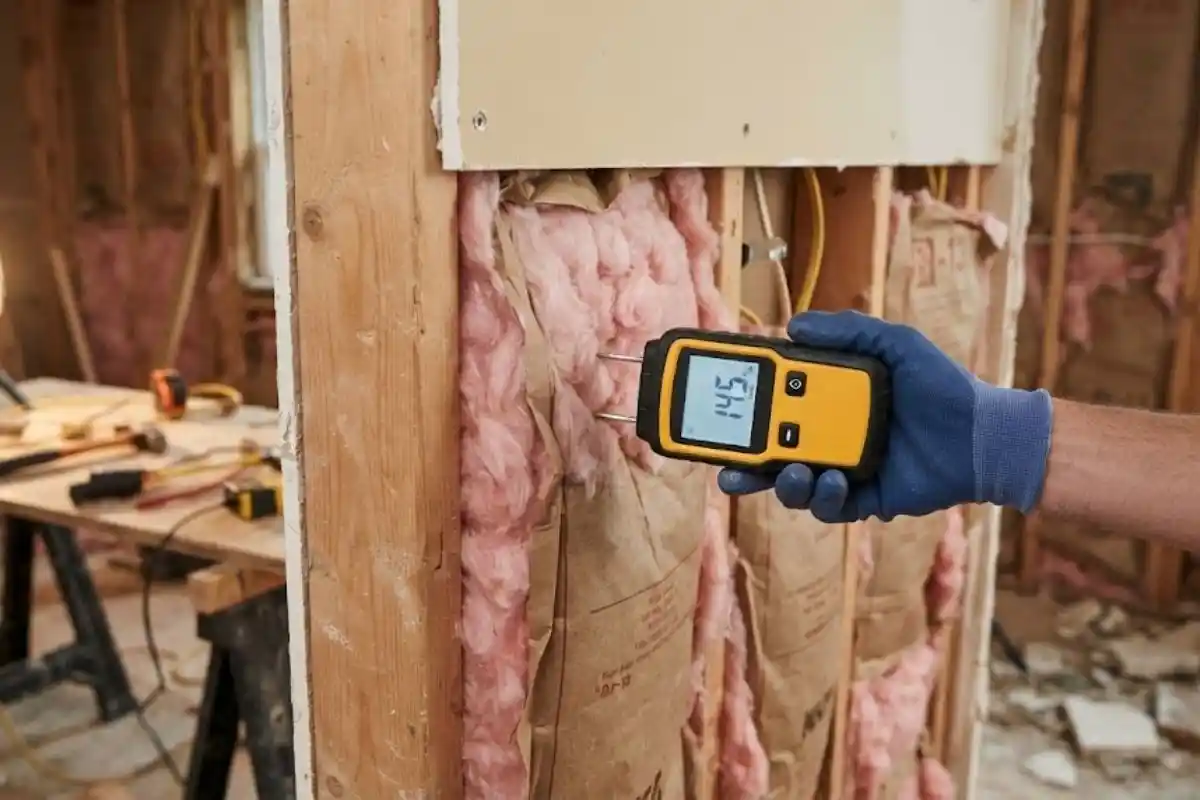
“How long until my wall is dry?” is one of the most common questions in this business, and the honest answer disappoints people looking for a single number: it depends on what the wall is made of, how wet it got, and what conditions surround it while it dries.
Here's the real, materials-by-materials breakdown, and why professional drying relies on measurement rather than a calendar.
Why There's No Single Answer
A wall assembly is several different materials layered together, drywall or plaster facing, insulation inside the cavity, framing behind that, and sometimes a vapor barrier or sheathing, and each material absorbs and releases water at a completely different rate.
A wall isn't “dry” until every layer that got wet has released its water, which means the timeline is set by whichever material in that specific wall dries slowest, not by an average or a guess.
That's the entire reason moisture meters exist in this trade: they measure what's actually happening inside the material, because surface dryness and structural dryness are frequently weeks apart.
Material By Material
Drywall is the fastest-drying common wall material, typically one to three days under proper air movement and dehumidification, faster for surface wetting, slower if water wicked up several feet and saturated the paper facing and gypsum core deeply.
Insulation varies by type: fiberglass batt insulation, once wet, often can't be effectively dried in place at all and is typically replaced rather than dried, since its structure collapses and its insulating properties don't fully recover; cellulose insulation holds water longer and dries more slowly than fiberglass.
Wood framing dries considerably slower than drywall, commonly three to seven days for surface moisture, longer for framing that was saturated for an extended period, since wood absorbs deeply and releases gradually through its grain.
Plaster (found in older homes, including some of the region's original-era construction) dries slower still, often a week or more, due to its density and multi-layer composition over wood or metal lath.
Concrete and masonry below or within walls dry slowest of all, weeks in some cases, because they're dense, absorb deeply, and release moisture gradually even under aggressive drying conditions.
What Speeds It Up And What Slows It Down
Air movement across wet surfaces accelerates evaporation dramatically, which is why professional drying setups include strategically placed air movers rather than relying on ambient airflow.
Dehumidification removes the moisture that air movement releases into the room, and without it, evaporated moisture just re-condenses elsewhere or keeps humidity too high for continued evaporation. Movers and dehumidifiers work as a system, not independently.
Temperature matters because warm air holds and carries more moisture than cool air, so heated conditions generally dry faster than cold ones, within reason. And containment, sealing the drying zone rather than leaving it open to the whole house. Lets equipment concentrate its effect rather than fighting the humidity of adjacent rooms.
Montgomery County's humid summer conditions work against all of this somewhat, which is part of why professional dehumidification matters more here from June through September than it does in a drier climate or season.
How Professionals Actually Verify “Dry”
The industry standard isn't a timeline, it's a moisture-content target specific to the material, measured with a meter and compared against a dry standard (often established by checking an unaffected area of the same material in the same house, since acceptable baseline moisture varies by material and even by region).
Readings are taken at the same marked points daily, and the material is considered dry when readings stabilize at or near that baseline for a consistent period, not when a surface feels dry to the touch or a fixed number of days has passed.
This is why our structural drying service documents daily readings rather than quoting a flat number of days upfront, the equipment leaves when the numbers say so, and the numbers are the actual product of the service, not the machines themselves.
Why Rushing This Step Is The Most Expensive Shortcut In Restoration
Closing a wall, hanging new drywall, painting, reinstalling trim, over a cavity that reads dry at the surface but remains wet in the framing or insulation behind it is how a manageable water event becomes a full mold remediation months later.
The materials most likely to fool a rushed assessment are exactly the slow-drying ones: framing and plaster can feel bone-dry at the surface while holding meaningful moisture several inches deep, invisible until symptoms, a musty smell, a returning stain, visible growth. Announce that the shortcut didn't work.
The few extra days a slow-drying material needs are inexpensive compared to the alternative; our mold removal and mold damage repair teams see the rushed-drying outcome regularly, and it's consistently a larger job than patience would have required the first time.
If you're currently drying out a wall yourself with a box fan and hope, the honest recommendation is a moisture meter reading before you close anything back up, a five-minute check against a number, rather than a guess against a calendar.
A Practical Rule Of Thumb, If You Need One
If a single number is unavoidable, here's the honest compromise: budget three to five days of active drying for a typical drywall-and-framing wall assembly with clean-water exposure caught within the first day, and expect that number to extend meaningfully for plaster, dense masonry, contaminated water categories, or any assembly that sat wet for an extended period before drying began.
Treat that range as a starting estimate to plan around, not a completion guarantee.
The meter readings, not the calendar, are what actually tell you when a specific wall in your specific house is done. Every day of premature confidence saved on the front end tends to cost several times over if it turns out to have been wrong. And a moisture meter reading takes less time than reading this paragraph did.
A Closing Thought On Patience
Drying is the least exciting phase of any water job, and it's tempting to treat the meter readings as a formality once the wall looks and smells fine. It isn't a formality. It's the only part of the process that actually tells you the job is done rather than just looking done.
Dealing with this right now in the Montgomery Village area? Our dispatch line is answered 24/7: (240) 207-7823