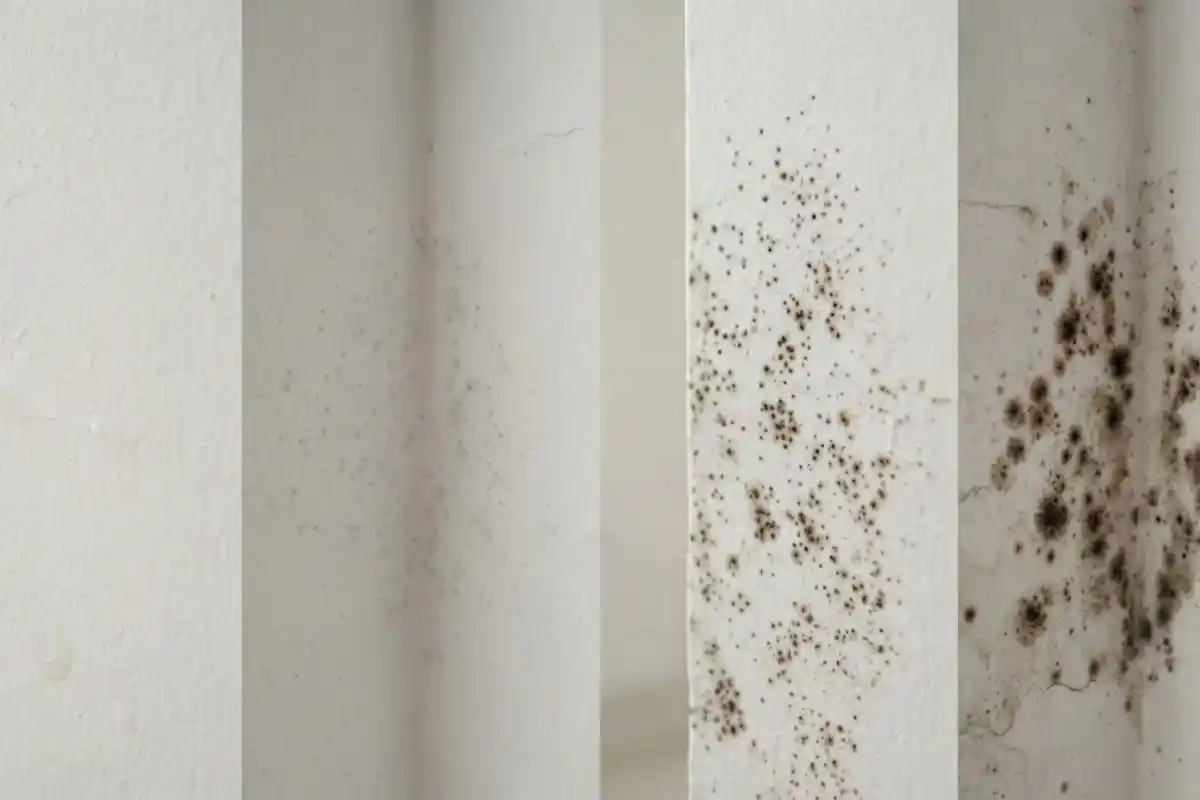
The number every restoration professional will give you is 24 to 48 hours, that's the industry-standard window, backed by the IICRC (the certification body for this trade), between water exposure and the beginning of mold growth. It's a real number, not a scare tactic.
But it compresses a more useful story: what's actually happening hour by hour after water gets into your home, which conditions move the timeline, and at what point the job changes from “dry it out” to “remediate it.” Here's the honest version.
The Hour-By-Hour Reality
Hours 0–24: Nothing is growing yet. But everything is being decided. Mold spores are already in your home; they're in every home, floating inert in the air, waiting for moisture.
During the first day, water is spreading through materials: wicking up drywall, soaking into carpet pad, migrating into wall cavities. Every surface it reaches becomes a candidate growing site. Water extracted and drying started in this window usually means no mold chapter at all.
Hours 24–48: Germination begins on the wettest, most nutritious surfaces, drywall paper, wood, the organic dust film on nearly everything. You can't see it. It doesn't smell yet. But microscopically, colonies are establishing, and the drying that would have prevented growth is now racing it.
Days 2–7: Colonies expand and begin releasing new spores, seeding adjacent damp areas. Somewhere in this window, many homeowners notice the first musty odor, that smell is microbial activity announcing itself, and it reliably precedes visible growth.
Days 7–21: Growth becomes visible: spotting on walls, fuzz on baseboards, discoloration at the carpet edge. By the time you can see mold, it has typically been growing for one to three weeks, which means the water event behind it is older than the mold looks.
What Moves The Timeline In Maryland
The 24–48 hour figure assumes ordinary indoor conditions. And Montgomery County summers are better than ordinary, from mold's perspective. Growth accelerates with warmth (the 70s and 80s are ideal) and humidity above roughly 60%, which describes most un-air-conditioned local spaces from June through September.
A basement that catches water in January has more forgiveness in its timeline than the same basement in July; we see the difference in our own dispatch outcomes every summer.
Material matters too. Drywall and carpet pad are the fast lanes. Porous, organic, and moisture-retaining. Sealed hard surfaces are the slow lane. And water category counts: contaminated water from a sewage backup or exterior flooding arrives pre-loaded with microorganisms and organic nutrients, cutting the timeline further.
The factor homeowners most underestimate is hidden moisture. A floor that's toweled off and a wall that feels dry can sit above a saturated pad or in front of a wet cavity for weeks.
Mold's timeline runs on the moisture you can't feel, not the surface you can, which is why professional work relies on moisture meters rather than touch, and why our structural drying service exists as its own discipline.
Leak Mold Vs. Humidity Mold: Two Different Timelines
One distinction worth understanding, because it changes both the timeline and the fix: mold from a water event versus mold from ambient humidity. Event-driven mold follows the timeline above. A leak or flood starts the clock, and growth maps the water's footprint.
Humidity-driven mold runs a slower, sneakier schedule: no single event, just a damp basement, an unventilated bathroom, or a closet against an exterior wall where condensation feeds growth gradually over a season. It shows up scattered across cool, low-airflow surfaces rather than tracking a leak path.
The reason the distinction matters: event mold ends when you fix the leak and remediate; humidity mold returns after any cleanup until the moisture balance changes.
If you're finding growth with no water event you can name, especially in closets, behind furniture, or across a basement, you're likely in the second category, and the answer involves dehumidification and airflow, not just removal. Our mold inspection service exists largely to make this exact determination.
When It's Too Late To Just Dry
The practical question behind the timeline: at what point does a water problem become a mold problem? Honest rules of thumb from our working week:
Water addressed within 24 hours, with real extraction and monitored drying. Mold is usually preventable outright. Water that sat 2–4 days, assume early growth in the wettest materials; drying still matters enormously, but the scope likely includes removing some materials and treating others.
Water discovered after a week or more, a vacation-timed sump failure, a slow leak found late, plan on remediation as part of the job, not a maybe. And any musty odor, at any point, means the microbial phase has started regardless of what's visible.
None of these thresholds mean panic; all of them mean the response should match the timeline honestly.
The most expensive outcomes we see aren't the fast-moving emergencies, they're the “it seemed to dry out fine” events that resurface as full remediation jobs a month later, usually after new drywall or fresh paint has sealed the problem in.
The Bottom Line
Mold's 24–48 hour head start is real, but it's a race you can win with speed: extraction within hours, drying verified with meters rather than fingertips, and honest scoping when the timeline has already run long.
If you're reading this with a wet floor somewhere in the house, the useful version of this article is one sentence: the value of the next few hours is higher than it will ever be again. Act inside them.
A Local Footnote On Humidity Season
One Montgomery County-specific coda: our dispatch data has a shape, and July through September is its peak mold season.
Ambient humidity in the 60s and 70s means every water event of summer runs on the compressed timeline, natural evaporation barely helps, and un-air-conditioned basements sit in mold's preferred conditions around the clock.
If a water event happens to your home in summer, treat every number in this article as its aggressive edge, and if you're reading this in January, you've been granted the timeline's slow lane, but only the slow lane, not a parking space. The physics forgive nothing; they just invoice later.
Either season, verified drying, meters, not fingertips, is what actually closes a water event, and it's the single habit that separates homes that never meet our remediation crews from homes that do.
Dealing with this right now in the Montgomery Village area? Our dispatch line is answered 24/7: (240) 207-7823