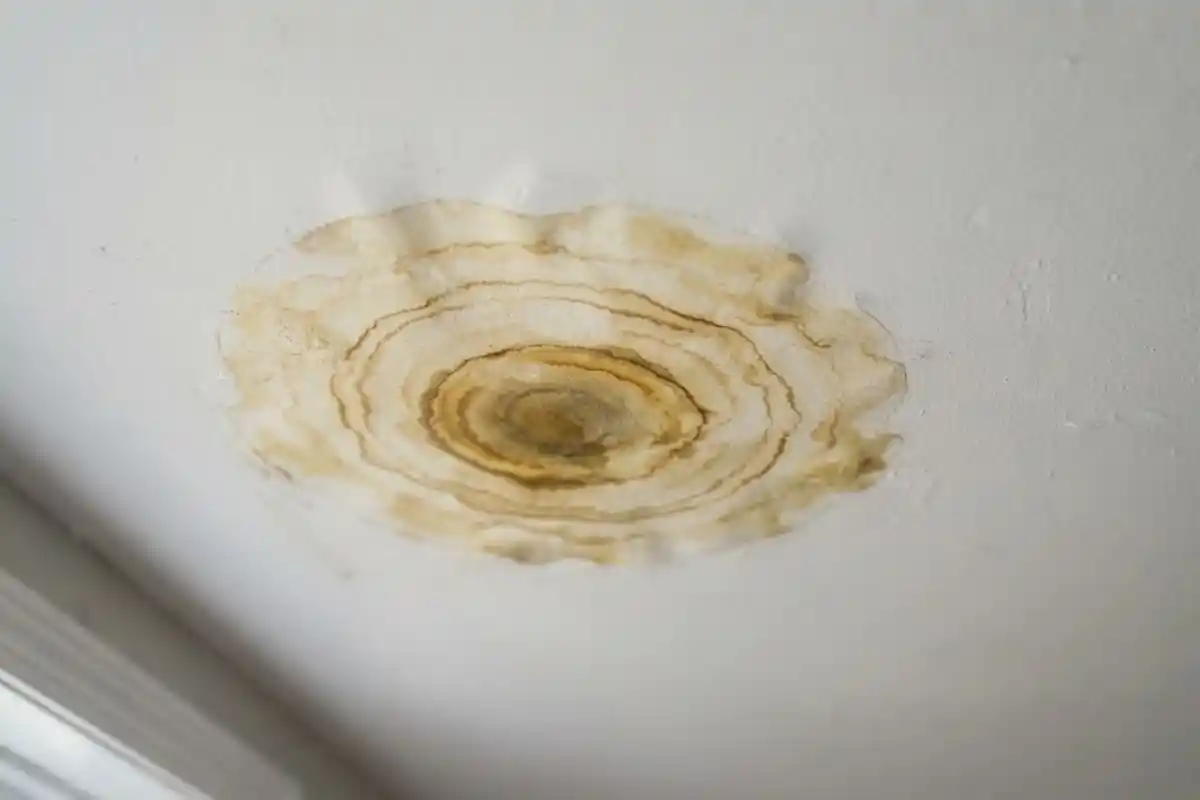
Of all the ways homes ask for help, the ceiling stain is the most politely ignored. It's small, it's dry to the touch, it's been there a while. And it's the visible end of a moisture path whose other end is the actual problem.
When homeowners finally call us about ceilings, the words we hear most are “soft spot” and “it feels like a hole is forming”, which is the stain's final stage, not its first. This post is about reading the earlier stages, while the fix is still small.
Reading The Stain
Stains carry diagnostic information if you look closely. A brown or yellow ring with a darker perimeter is the classic slow-leak signature, water arriving intermittently, spreading, and evaporating, with minerals and tannins concentrating at the edge; multiple rings mean multiple wetting cycles, which means the source is still active or weather-dependent.
A stain that's uniformly damp or growing week over week is an active, continuous leak.
A stain directly below a bathroom points to the most common culprit in our dispatch log, a wax ring, tub drain connection, or supply line in the floor cavity above. A stain at the ceiling's edge against an exterior wall suggests roof, gutter, or flashing issues, or wind-driven rain finding a gap in siding.
A cause that shows up more than most people expect and typically only during storms from a particular direction. And a stain that appears in winter, high on the ceiling near the eaves, raises the ice-dam and attic-condensation questions.
Location, shape, and behavior over time narrow the source considerably before anyone opens anything, which is why photographing a stain monthly (same angle, same light) is genuinely useful homeowner data.
The Stages, From Shadow To Soft Spot
Ceiling water damage progresses predictably. Stage one is discoloration: the cavity above has gotten wet at least once, and the drywall is reporting it. Stage two is texture change, bubbling paint, tape seams showing, a slight ripple.
The drywall is absorbing repeated moisture and its paper facing is beginning to fail. Stage three is the soft spot: press gently and the surface gives, because the gypsum core is saturated and structurally spent.
Stage four is sagging. The drywall is holding water by the pound and its fasteners are working loose. And stage five is failure, usually sudden and usually messy.
The stage matters because the intervention scales with it. Stage one, caught and traced, is often a source fix plus a sealed-and-painted stain. Stage three is a drywall replacement and a wet cavity to dry. Stage five is a room-sized cleanup plus everything below. The economical moment is always earlier than the alarming one.
If The Ceiling Is Bulging Right Now
A bulge that looks water-filled deserves immediate, slightly counterintuitive action: put a bucket under it and relieve it deliberately. A small puncture at the bulge's low point. A screwdriver works, drains the trapped water in a controlled stream instead of letting the drywall choose its own moment to fail across the whole span.
Then stop the supply if you can identify the fixture above, and make the call. Controlled drainage feels like damaging your own ceiling; it's actually the cheapest square inch of damage available, purchased against the whole panel's collapse.
Why Painting Over It Is The Expensive Option
The most common ceiling-stain decision is a coat of stain-blocking primer and a Saturday. And sometimes that's exactly right.
The test is a moisture reading, and it takes about a minute: a dry, old stain over a dry cavity seals and paints permanently; a stain over a damp cavity bleeds through fresh paint within weeks while the moisture keeps working on the framing, insulation, and subfloor above.
Painting without measuring is a coin flip where one outcome costs a can of primer and the other costs a renovation, because sealed-in moisture doesn't stop, it just stops reporting. The cavity above a painted-over active stain continues soaking, molding, and corroding in private until the problem re-announces itself at a much later stage.
Our ceiling water damage repair service leads with exactly this trace-first sequence: source, cavity, moisture verification, and only then the cosmetic finish.
The Townhome Wrinkle
One local complication worth naming: in Montgomery Village's townhome clusters and attached housing across the county, the plumbing above your ceiling isn't necessarily yours.
Shared risers and party-wall plumbing mean a neighbor's failing connection can present as your stain, and diagnosing across a unit boundary takes coordination, moisture direction-finding on your side, access cooperation on theirs, and documentation that lets two insurance carriers (sometimes plus an HOA) each see their piece.
If your stain sits against a shared wall and your own fixtures check out, that's the scenario to suspect, and it's one we work regularly. The stain doesn't care whose water it is; the claim very much does.
Whatever your ceiling is telling you, the summary is the same: stains are information, soft spots are deadlines, and the moisture meter, not the paint can, is the first tool that should touch either.
If yours has been waiting patiently on the to-do list, an assessment turns it from a question into a plan in one visit.
What An Assessment Actually Involves
If the stain has you deciding between the primer can and the phone call, here's what the call buys: a moisture-meter reading of the stain and the cavity behind it (the one-minute answer to paint-or-investigate), a trace of the moisture path toward its source, fixture, roof, siding, or riser, using readings rather than guesswork, and a written finding either way.
If the cavity is dry and the source is historical, you leave with permission to paint and the reading that proves it.
If it's wet, you leave with a scope that's smaller than it will ever be again. Ceiling stains are the rare home problem where the diagnostic is fast, cheap, and definitive. The expensive versions of this story all begin with skipping it.
Dealing with this right now in the Montgomery Village area? Our dispatch line is answered 24/7: (240) 207-7823