Nobody shopping for water damage restoration is having a good day, and the pricing opacity of this industry doesn't help. So here's the honest version: the real ranges, the variables that actually move the number, why two identical-looking basements can produce very different invoices, and the questions that separate a fair quote from a fishing expedition.
Ranges below reflect typical residential work in our Montgomery County service area; your specific number comes from a documented assessment, not a webpage, ours or anyone's.
The Baseline Ranges
For orientation: straightforward water extraction and structural drying for a typical affected area runs roughly $1,200–$4,500. Flooded basement cleanups, extraction, contents handling, pad removal, drying, commonly land $1,500–$5,000 depending on finish level and dwell time.
Sewage cleanup runs $800–$3,500 for fixture-level events, more for whole-basement Category 3 losses, because contamination protocols add labor and disposal at every step. Mold remediation spans $500 for a small contained area to $3,000+ for multi-surface jobs, with structural or whole-basement scopes above that.
And full restoration after major losses, the rebuild side with drywall, flooring, and finish work, scales with what the water reached, commonly $3,000–$12,000+ on significant events. Wide ranges, honestly stated, because the variables below are doing the real work.
The Four Variables That Actually Set The Price
Water category. Clean supply-line water, gray water, and Category 3 sewage are three different jobs on the same square footage. Contamination determines what can be dried versus what must be removed, what protective protocols apply, and what disposal costs. A clean-water basement and a backup basement of identical size can differ by half the invoice.
Dwell time. How long the water sat before response is the quiet multiplier. Water addressed in hours means maximum salvage and minimum drying; water that sat through a long weekend means saturated materials past saving, a mold clock already running, and scope that grew while nobody watched.
This is the honest reason emergency response exists. The fast call is the cheap call, every time.
What the water touched. An unfinished utility basement is extraction and drying. The same gallons across a finished rec room, carpet, drywall, built-ins, contents, multiplies every phase. Finish level, not flood size, frequently decides the bill.
Vertical travel. Water that stayed on one level is one scope; water that originated upstairs and traveled through floor cavities and ceilings is several. Multi-level losses carry cavity drying, ceiling repair, and mapping work single-level events don't.
The Bundled Question: Water Plus Mold
A growing share of the calls we take ask for exactly this: one quote covering both the water damage and the mold that followed it, usually because the water event happened weeks ago, dried “well enough,” and has now announced its second act.
It's the right instinct. Bundled water-and-mold scopes assessed in one visit consistently beat the two-vendor version on both price and outcome: one mobilization instead of two, no gap between the drying and the remediation where moisture recovers, one documentation package for the insurer, and no boundary dispute about where the water contractor's responsibility ended and the mold contractor's began.
If your situation has both components, and any water event past the 48-hour mark should assume it might, ask for the combined assessment explicitly. The remediation side of our house exists precisely because water jobs and mold jobs are usually the same job at different ages.
How Insurance Changes The Math
When the loss is covered, and sudden internal water events generally are, the cost conversation restructures: your number becomes the deductible plus anything outside coverage, and the documentation becomes the product.
Room-by-room moisture readings, dated photos, itemized scopes, and drying logs are what move claims smoothly; their absence is what turns covered losses into negotiations. Two cautions from the claims trenches: mitigation is a policyholder duty, so waiting for adjuster approval before stopping active damage works against you, not for you.
Reasonable emergency steps are claimable and expected, which is the standard our water mitigation team documents from the first visit.
And “we bill your insurance directly, you pay nothing” pitches deserve scrutiny; the assignment-of-benefits fine print behind some of them has a documented history of surprising homeowners. A restoration company should make your claim easier and your paperwork bulletproof. Not become a party to your policy.
How To Read Any Quote, Including Ours
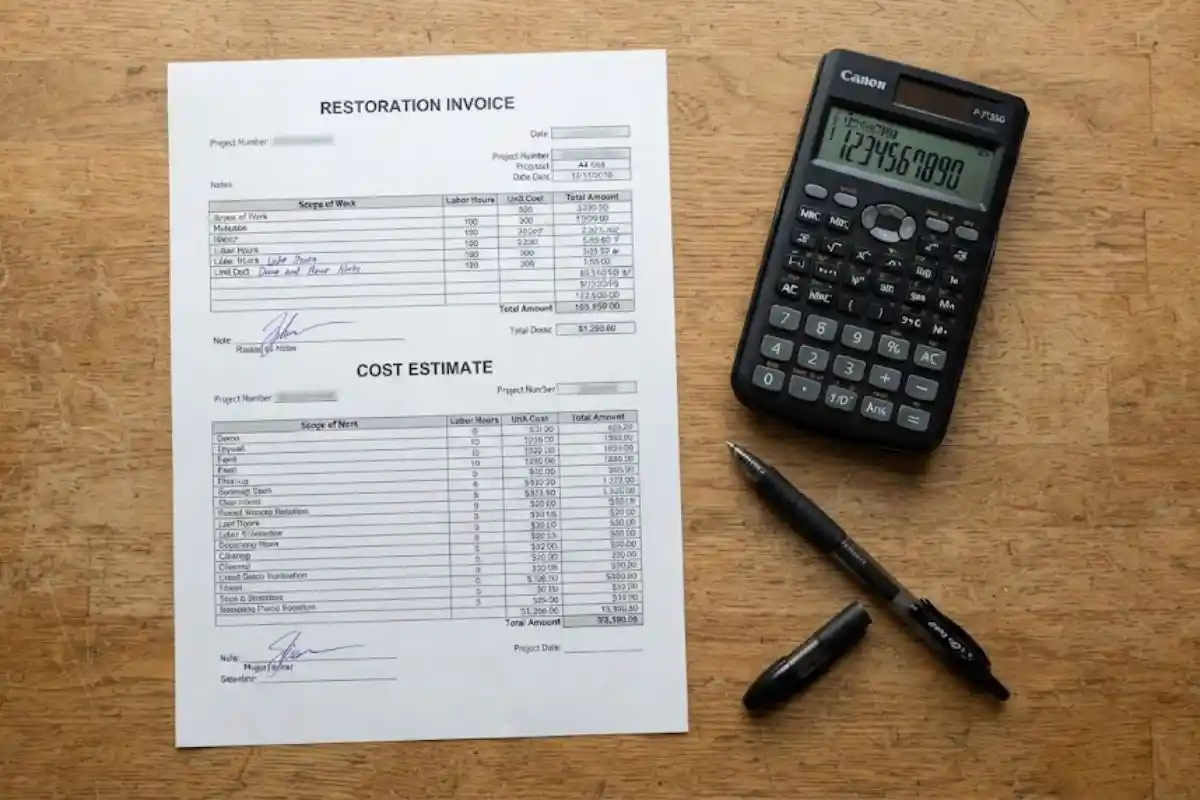
A trustworthy water damage quote has visible anatomy: scope described by room and task, drying listed with duration and verification method (equipment-days with meter targets, not “until dry”), demolition and disposal separated from restoration, and the trigger conditions for scope changes stated up front, because water jobs do grow when walls open, and the honest version is a documented change order, not a surprise invoice.
Questions worth asking anyone: What's the water category and how did you determine it? What are the moisture readings now, and what targets end the drying? What happens if you find growth when the wall opens?
Clear answers cost a contractor nothing; vague ones are their own information. Every job we run starts with a written, itemized assessment for exactly this reason. The number should survive scrutiny before the first machine switches on.
The Cheapest Dollar In The Whole Equation
Ending where the math actually points: the least expensive money in water damage is the money spent earliest.
The emergency call that beats the 48-hour mold window, the extraction that shrinks the drying, the drying that prevents the remediation, the camera inspection that predicts the next backup, the sump battery that prevents the whole file, every dollar moves further the earlier it enters the timeline.
Restoration pricing looks opaque from outside, but its deepest pattern is simple: scope follows time, and time is the one variable the homeowner controls completely. Whatever your situation costs today, its version tomorrow costs more, which is the most honest pricing guidance this industry has to offer.
Keep our number, or any reputable company's. Saved before you need it, know your main shutoff, and the expensive version of this article stays hypothetical.
Dealing with this right now in the Montgomery Village area? Our dispatch line is answered 24/7: (240) 207-7823