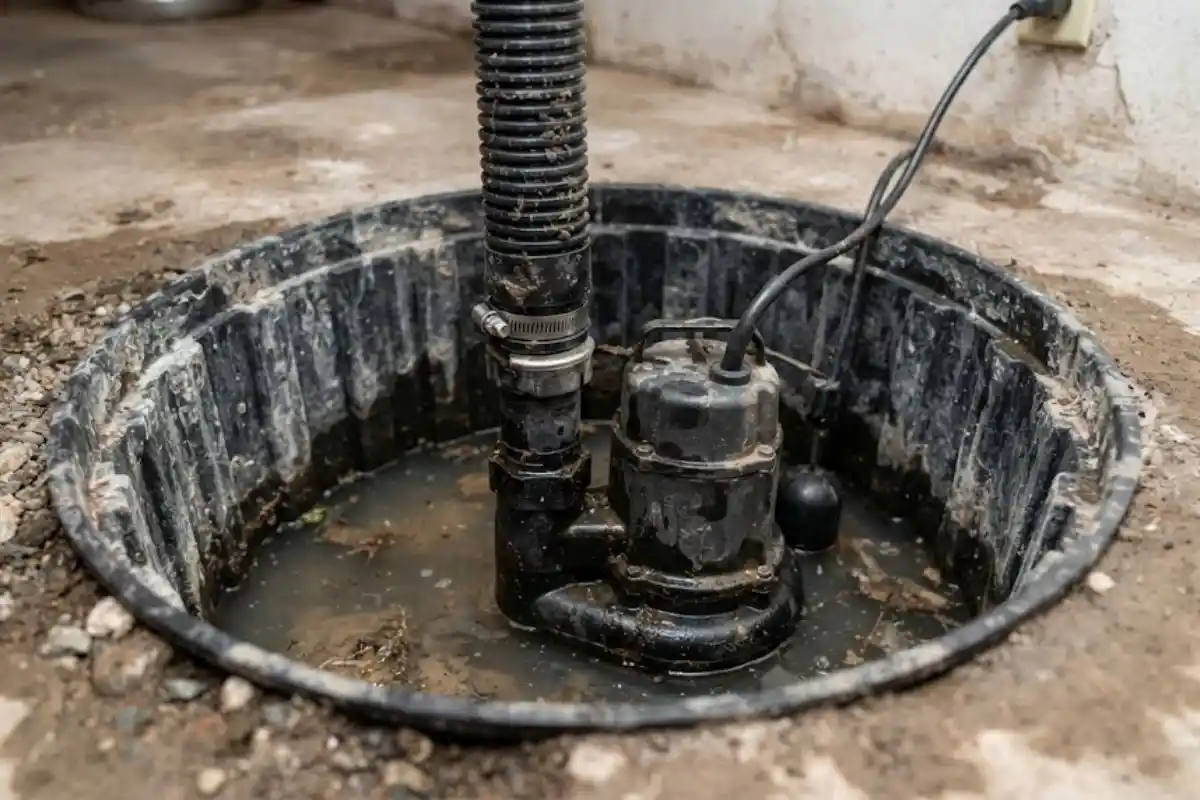
If we had to name the single mechanical failure behind more Montgomery County basement floods than any other, it's the sump pump. Not because sumps are unreliable equipment, but because they're invisible equipment.
A pump can run flawlessly for years, quietly, in a pit nobody looks at, until the one week it's needed most, it doesn't. This post is about catching the failure before the flood, because nearly every sump failure gives warning first.
Why Sumps Fail When You Need Them Most
Sump pumps have an unfortunate design irony: they're least exercised exactly when conditions are calm, and most stressed exactly when conditions turn severe, which means age-related weaknesses and heavy-demand failures arrive together, during the same storm.
A pump that's marginal all summer meets its actual test during the one week of sustained heavy rain, running continuously instead of its usual occasional cycle, and that's precisely when a worn bearing, a stuck float, or an undersized motor gives out.
The pump doesn't fail randomly; it fails under the load it was always going to face eventually, at the worst possible moment to discover it.
The Warning Signs, In Order Of Urgency
Unusual noise. A healthy pump has a consistent sound signature; grinding, rattling, or a labored motor pitch signals a bearing or impeller problem developing toward failure, often weeks before it actually quits.
Short-cycling or long-running. A pump cycling far more often than the weather explains, or running continuously without shutting off, is fighting something, a failing check valve letting water flow back into the pit, a float switch malfunctioning, or genuinely rising water table pressure it can barely keep pace with.
Visible rust or age. Sump pumps have a service life, typically 7–10 years for a reasonably used unit. Visible corrosion on the pump body or a pit that's clearly original to a house older than a decade is a countdown, not a maybe.
The pit runs drier or wetter than it used to. A pit that used to cycle regularly and now rarely triggers may indicate the pump isn't sensing water properly, not necessarily good news, since water may be entering and not being removed.
A pit that stays fuller than normal between cycles suggests the pump can't keep pace with current inflow.
No backup power. This isn't a sign the primary pump is failing, it's a sign the system as a whole will fail the moment power does, and Maryland storms take out both at once with some regularity.
The Two Seasons That Break Sumps
Summer failures come from sustained saturation: weeks of wet ground keep a pump cycling near-continuously, and continuous operation is what finds a bearing's weak point or a motor's thermal limit. Winter failures come from a different mechanism entirely.
The discharge line, which runs to daylight outside the foundation, freezes solid at its exterior exit. The pump then runs against a blocked line, either overheating and failing or simply losing anywhere for the water to go, and the pit overflows despite a pump that's technically still working.
A frozen discharge line is one of the most common “but the pump was fine!” calls we take, and it's entirely preventable with a properly sloped, sufficiently buried, or heat-taped discharge run.
The Five-Minute Test
Before the next storm, and ideally on a recurring seasonal schedule. Run this check. Pour a few gallons of water into the pit and confirm the float rises, the pump kicks on promptly, and water actually exits through the discharge line outside the house (not just that the pump runs; confirm the water leaves).
Listen for the sound signature and compare it to memory. Check the discharge line's exterior exit for any obstruction, ice, or debris.
And if you don't have a battery backup or water-powered backup pump, this is the moment to seriously consider one, the systems that saved basements during Montgomery County's July 2025 flash flood were overwhelmingly the ones with backup power already in place before the storm arrived, not the ones scrambling during it.
When The Pump Has Already Failed
If you're reading this with water already in the basement, the diagnosis matters less than the response right now. Our flooded basement cleanup service covers the immediate steps.
But once the water's out and dried, the pump failure deserves its own post-mortem: replace rather than repair anything past its service-life window, add battery or water-powered backup if you don't have it, and consider a second pump in the same pit for critical basements. Redundancy that costs a few hundred dollars and has prevented more repeat floods than any other single upgrade we recommend.
Our basement water removal and structural drying teams handle the water side of a sump failure daily; the prevention side is genuinely in your hands, and it's cheaper every single time than the cleanup.
The Cost Comparison Nobody Argues With
Put plainly: a battery backup sump system runs a few hundred dollars installed. A basement flood cleanup, even a modest one, routinely exceeds that before any flooring or drywall replacement is counted, and a flood that reaches finished basement contents can multiply from there fast.
We're not aware of a single homeowner who regretted installing backup power after a storm proved its worth, and we've met plenty who regretted skipping it, usually while standing in the basement it was supposed to protect.
If this article prompts exactly one action, let it be checking whether your sump has backup power before the next storm makes the question urgent instead of optional.
Our basement water removal crews see both outcomes every storm season, and the difference between them is almost never luck. It's almost always whether backup power was installed before the storm needed it or after.
If you've read this far and still aren't sure whether your own sump has that backup, that uncertainty is itself worth resolving this week rather than the week after the next storm.
Dealing with this right now in the Montgomery Village area? Our dispatch line is answered 24/7: (240) 207-7823